Email: SalesDept@topcomponents.cc

Skype: jinda808@vip.163.com

QQ: 119294586

WeChat: 

WhatsApp: +8613027986268
Language Translation
- • English
- • Русский язык
* Please refer to the English Version as our Official Version.
* Please refer to the English Version as our Official Version.
On August 14, 2025, WPG Holdings, a leading international semiconductor component distributor serving the Asia-Pacific market, announced that its subsidiary, Quan Ding, has launched an AI-powered fatigue driving detection solution based on the Synaptics SL1680 embedded processor.
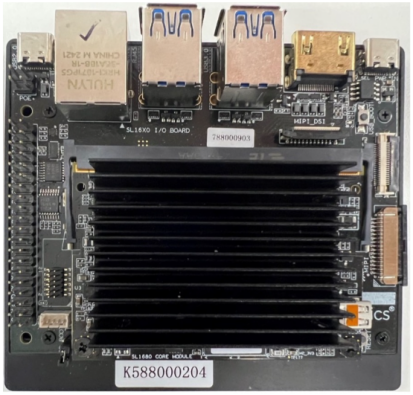
Figure 1 - Display board of WPG Quan Ding's AI fatigue driving detection solution based on Synaptics products
During long-distance driving, monitoring driver status can significantly improve road safety. However, traditional driver monitoring technologies are limited by poor accuracy and delayed response, making them incapable of meeting the requirements for accurate and real-time monitoring. Against this backdrop, WPG Quan Ding has launched an AI-powered fatigue driving detection solution based on the Synaptics SL1680 embedded processor. Deeply integrating artificial intelligence technology, this solution enables efficient identification and precise analysis of driver status, providing strong support for real-time risk warnings and accident prevention.
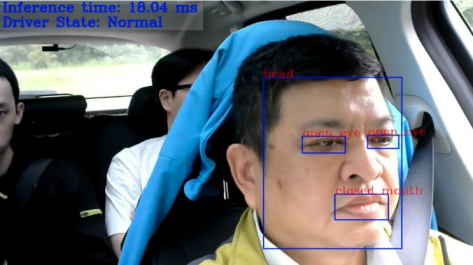
Figure 2 - Application scenario diagram of Dalian Daquanding's AI driver fatigue detection solution based on Synaptics products
Synaptics' Astra™ SL series embedded processors are highly integrated AI-native Linux and Android system-on-chips (SoCs), hardware-optimized for consumer, enterprise, and industrial Internet of Things (IoT) workloads. They feature hardware accelerators to support edge inference, security requirements, graphics processing, visual computing, and audio applications.
The SL1680, a member of the Astra™ SL series embedded processors used in this solution, integrates a high-performance computing engine, including a quad-core Arm® Cortex®-A73 64-bit CPU subsystem, a 7.9+ TOPS neural network processing unit (NPU), and an efficient, versatile GPU designed for advanced graphics and AI acceleration. Furthermore, the product features hardware modules for image signal processing (ISP), 4K video encoding and decoding, and audio acceleration, meeting the multimodal application needs of niche markets.
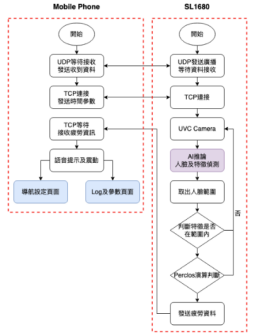
Figure 3 - Block diagram of DaLian DaQuanDing's AI drowsy driving detection solution based on Synaptics products
In addition, Synaptics' Astra Machina Foundation series evaluation kit enables easy and rapid prototyping with the Astra SL series multi-mode embedded processors. Its modular design includes interchangeable core computing modules, universal I/O boards, and daughter cards for connectivity, debugging, and flexible I/O options, offering high scalability and convenience.
The SL1680 embedded processor used in this solution is a high-performance, low-power AI-native SoC that provides a stable hardware foundation for driving safety solutions. Combined with advanced AI models, it enables real-time, accurate drowsy driving detection, thereby improving driving safety and reducing accident risks.
Core Technology Advantages:
High-Performance Processing Architecture:
• Equipped with a quad-core Arm Cortex-A73 processor, it provides powerful processing power for compute-intensive tasks and is suitable for multi-tasking and complex workloads.
• Supports mainstream AI frameworks (such as TensorFlow Lite, ONNX, and YOLO) and supports quantized model execution, further improving efficiency.
Highly Integrated Multimedia Processing:
• Equipped with a GPU that supports advanced graphics processing and AI acceleration, it is suitable for high-definition user interfaces and complex visual applications.
• Supports 4K video encoding and decoding standards such as H.264 and H.265, enabling smooth multimedia processing for applications such as in-vehicle displays and streaming media.
Edge AI Computing:
• Supports local inference of AI models, reducing reliance on the cloud and achieving low-latency real-time responses, improving security and user experience.
• Equipped with a variety of dedicated hardware accelerators, it is optimized for specific computing needs, such as image processing, visual reasoning, and audio processing.
Diverse I/O Support and Scalability:
• Multiple I/O interfaces (such as USB, PCIe, I2C, SPI, etc.);
• Supports multiple camera inputs to meet the needs of multi-view applications such as automotive and surveillance.
Solution Specifications:
Core Module Main Components:
• Synaptics SL1680 quad-core Arm Cortex-A73 embedded IoT processor, with a maximum frequency of 2.1GHz;
• Storage: eMMC 5.1 (16GB);
• Memory: Two x32 16Gbit LPDDR4 memory slots, providing x64 4GB of system memory;
• Power Management IC (PMIC): Two support dynamic voltage and frequency scaling (DVFS) for the Vcore and Vcpu power rails;
• HDMI Micro Rx interface: V2.1 specification, HDCP 2.2 support, providing up to 4K60p video and advanced audio;
• SD card slot.
I/O Board Key Components:
HDMI Type-A Tx port: V2.1 specification, HDCP 2.2 support, providing up to 4K60p video and advanced audio;
M.2 E-key 2230 slot: supports SDIO, PCIe, and UART for Wi-Fi/BT modules;
USB 3.0 Type-A: 4 ports, supports host mode, with transfer speeds up to SuperSpeed;
USB 2.0 Type-C: supports OTG host or peripheral mode, with transfer speeds up to Hi-Speed;
Button: For USB-BOOT selection and system reset (RESET);
2-pin header: For SD-BOOT selection.
Expansion Daughter Card Interface Options:
• MIPI DSI: A 22-pin FPC interface supports 4-lane DSI and features I2C and GPIO, suitable for display panels up to 4K30p/2K60p.
• MIPI CSI-2: Provides two FPC interfaces: CSI0 is a 22-pin interface supporting 4 lanes, and CSI1 is a 15-pin interface supporting 2 lanes. Each interface features I2C and GPIO, suitable for up to 4K60p (single camera) or 4K30p (dual camera).
• JTAG Daughter Card: For debugging.
• 40-pin connector: Provides additional functionality.
• 4-pin PoE+ Daughter Card: Supports the added voltage regulator module for power supplies compliant with the PoE+ Type 2 (802.3at) specification. Provides 25.5W (Class 4) of 5V power to the 40-pin connector on the I/O board.
• 4-pin connector: For PWM active fans.
• Type-C power supply: Provides 15V, 1.8A.
About The Author
This is reported by Top Components, a leading supplier of electronic components in the semiconductor industry. They are committed to p with the most necessary, outdated, licensed, and hard-to-find parts.
Media Relations
Name: John Chen
Email: salesdept@topcomponents.ru