Email: SalesDept@topcomponents.cc

Skype: jinda808@vip.163.com

QQ: 119294586

WeChat: 

WhatsApp: +8613027986268
Language Translation
- • English
- • Русский язык
* Please refer to the English Version as our Official Version.
* Please refer to the English Version as our Official Version.
Introduction
To achieve the goal of a zero carbon society, electrification of transportation is crucial. Lighter and more efficient electronic components play an important role in this process. Car charger (OBC) is one example. How can compact transfer molded power modules meet the current needs of in car chargers (OBC)?
text
The development of electric transportation is advancing rapidly: in order to improve the autonomy and range of vehicles, electric drive powertrain systems are becoming increasingly efficient and compact. As a key component of this development process, in car chargers (OBCs) must be as small and lightweight as possible while maintaining high efficiency. This technological challenge must also ensure that costs are controlled within a limited range.
OBC is used for AC charging and requires single-phase or three-phase voltage provided by the power grid (charging station). The single-phase charging power range is 3.6kW~7.5kW, while the three-phase charging power supports 11kW~22kW. At present, in order to balance cost and efficiency, the mainstream OBC products in the market are mainly in the medium power range (11kW). The 22kW OBC is mainly used in the high-end market. However, all OBCs must support single-phase charging in order to still charge the vehicle even when power is limited. To achieve vehicle to grid (V2G) and vehicle to vehicle (V2V) charging solutions, there is an increasing demand for OBCs to have bidirectional charging capabilities.
So far, traditional OBC designs have mainly used standard discrete devices (THD or SMD packages) available in the market. Especially for SMD devices, there are many challenges due to the need for PCB heat dissipation or the use of suitable thermal interface materials to precisely fix each independent package on the heat sink for heat dissipation. This approach is approaching its limits in terms of power density improvement and system compactness, while power modules have shown significant advantages in the new generation of products.
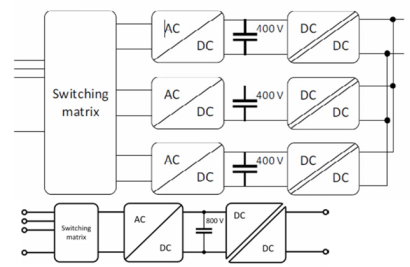
Figure 1: Modular (top) architecture and centralized (bottom) architecture of OBC
Architecture and Topology
There are two main types of OBC architectures (Figure 1): one is a modular architecture based on three identical single-phase modules; Another approach is a centralized architecture based on a three-phase AC/DC converter (which also supports single-phase operation). Both architectures can be implemented through unidirectional and bidirectional topologies.
Modular architecture requires more diverse devices, resulting in an overall increase in energy storage capacity requirements for DC links, which in turn drives up volume and cost. In addition, modular architecture requires additional configuration of gate drivers and voltage and current detection functions. In contrast, centralized architecture requires fewer components, thus enabling more cost-effective OBC, making it the preferred architecture for high power density OBC.
SiC modules can achieve higher efficiency and power density
SiC, with its excellent properties, has become a highly suitable power semiconductor material for OBC. ROHM's fourth generation SiC MOSFET adopts a trench structure, achieving ultra-low on resistance. In addition, its very low Miller capacitance can achieve ultra fast switching speed, thereby reducing switching losses. These characteristics result in lower total losses, which in turn can reduce the burden of heat dissipation design.
ROHM has launched a new product optimized specifically for OBC applications - HSDIP20 module, further expanding EcoSiC? Series of SiC MOSFET product lineup. This series of modules integrates 4 or 6 SiC MOSFETs in the full bridge circuit, which has many advantages compared to discrete devices using the same chip technology.
This series of modules uses aluminum nitride (AlN) ceramics to isolate the heat dissipation pads from the drain of MOSFETs. This makes its crust thermal resistance (Rth) very low, eliminating the need for thermal interface materials (TIM) to electrically isolate the heat dissipation pads from the heat sink.
Thanks to the application of mold materials, electrical isolation has been achieved between the chips in the power module. This means that chips can be arranged more tightly than discrete device solutions (in discrete device solutions, the creepage distance on the PCB must be considered). This design reduces the PCB footprint while increasing the power density of the OBC solution.
Less workload and lower risk
In addition to technological advantages, the internal isolation function can greatly simplify the work of developers: the module has built-in electrical isolation function. For solutions that use discrete components, isolation issues need to be addressed externally. The module has been tested by ROHM before delivery, so there is no need for additional electrical isolation testing during the OBC development phase. It can be seen that this series of modules can not only shorten the development cycle and reduce development costs, but also reduce the risk of insulation problems.
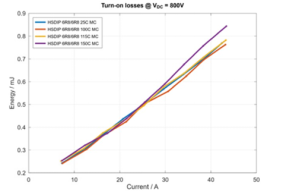
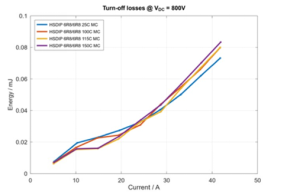
Figure 2: On and off losses of HSDIP module at different temperatures under 800V DC link voltage
The HSDIP20 module also has additional advantages brought by the 4th generation SiC MOSFET: its 0V turn off voltage can reduce the complexity and cost of PCB layout. As shown in Figure 2, at a DC link voltage of 800V, the HSDIP module using the 4th generation SiC MOSFET exhibits lower switching losses under different temperature conditions.
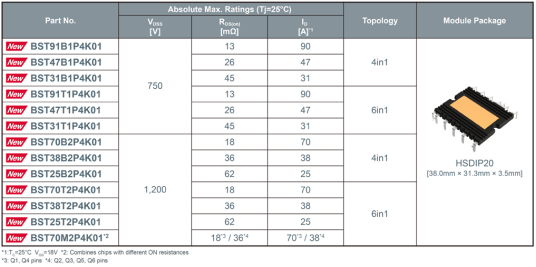
Figure 3: HSDIP20 power module product lineup based on 4th generation SiC MOSFET
Another advantage of the HSDIP20 module is its scalability. ROHM offers a wide range of RDS (on) specifications and topology options, making this series of modules suitable for OBC applications in different power ranges. At present, six 4-in-1 topology modules and six 6-in-1 topology modules are available. In addition, ROHM has also launched a "hybrid" module using a Six pack topology structure, which provides a low-cost solution for totem pole PFC circuits by combining MOSFETs with different RDS (on), and can easily achieve single-phase and three-phase operation using the same device. The modules of various topological structures are encapsulated in the same form, making application expansion very convenient. All power modules comply with the AQG324 standard.
Thermal characteristics and switch characteristics
In order to verify the advantages of the HSDIP module, R&D personnel conducted characteristic simulations and tests on the device. In the thermal performance demonstration of the module, a Six pack module equipped with 36m Ω and 1200V SiC MOSFET was used. The simulation is based on a single module installed on a liquid cooled plate, with the set conditions of single-chip loss between 25W and 35W, Ta=Tw=60 ° C, TIM thickness of 20 μ m, and thermal conductivity of 4.1W/mK. Simulate by simultaneously applying power to the chip, and draw the relationship curve between the dissipated power of each device and the junction temperature based on the simulation results (Figure 4).
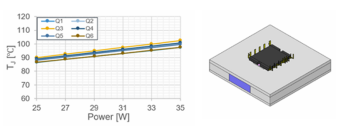
Figure 4: Simulation results of HSDIP module thermal performance
By optimizing the internal structure, this series of power modules achieves very low single-chip thermal resistance and has significant advantages in thermal performance. Its maximum junction temperature is much lower than the 175 ° C limit allowed by SiC MOSFETs, creating more space for improving power density and meeting the stringent requirements of high-power OBC.
The switching loss characteristics of a 6-in-1 module using 36mW, 1200V SiC MOSFET were evaluated on a test board simulating the AC/DC conversion stage in OBC applications. The switch loss results obtained through this test are shown in Figure 2. The switch loss results obtained through dual pulse testing and evaluation of this module are also applicable to the bidirectional DC/AC conversion stage discussed in this article. Based on this data, simulate the bidirectional DC/AC conversion stage of an 11kW system (Figure 5). The simulation results show that the 11 kW AC/DC converter stage constructed based on a 6-in-1 module using the 4th generation SiC MOSFET (36m Ω, 1200V) can achieve an efficiency of about 99% under the condition of a switching frequency of 48 kHz and the use of a forced air cooling radiator (this efficiency value only considers semiconductor losses).
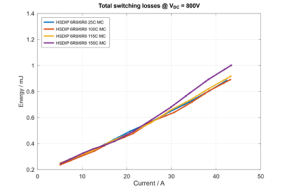
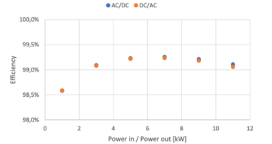
Figure 5: Efficiency simulation of HSDIP module in bidirectional AC/DC stage in OBC
Conclusion
In the OBC of electric and hybrid vehicles, modules consisting of 4 or 6 SiC MOSFETs have significant advantages compared to discrete device solutions. With its higher power density, this module can reduce the volume and weight of OBC and lower the complexity of design. ROHM's HSDIP20 module integrates the latest EcoSiC technology? MOSFET, The simulation results show that when applied to the AC/DC conversion stage of bidirectional OBC, this series of modules not only exhibits excellent thermal characteristics, but also achieves an efficiency of about 99%.
About The Author
This is reported by Top Components, a leading supplier of electronic components in the semiconductor industry
They are committed to providing customers around the world with the most necessary, outdated, licensed, and hard-to-find parts.
Media Relations
Name: John Chen
Email: salesdept@topcomponents.ruThis is reported by Top Components, a leading supplier of electronic components in the semiconductor industry. They are committed to p with the most necessary, outdated, licensed, and hard-to-find parts.
Media Relations Name: John Chen
Email: salesdept@topcomponents.ru